The Asset That Doesn't Depreciate
Five findings I've shared separately this month — and what I'd propose they say together.
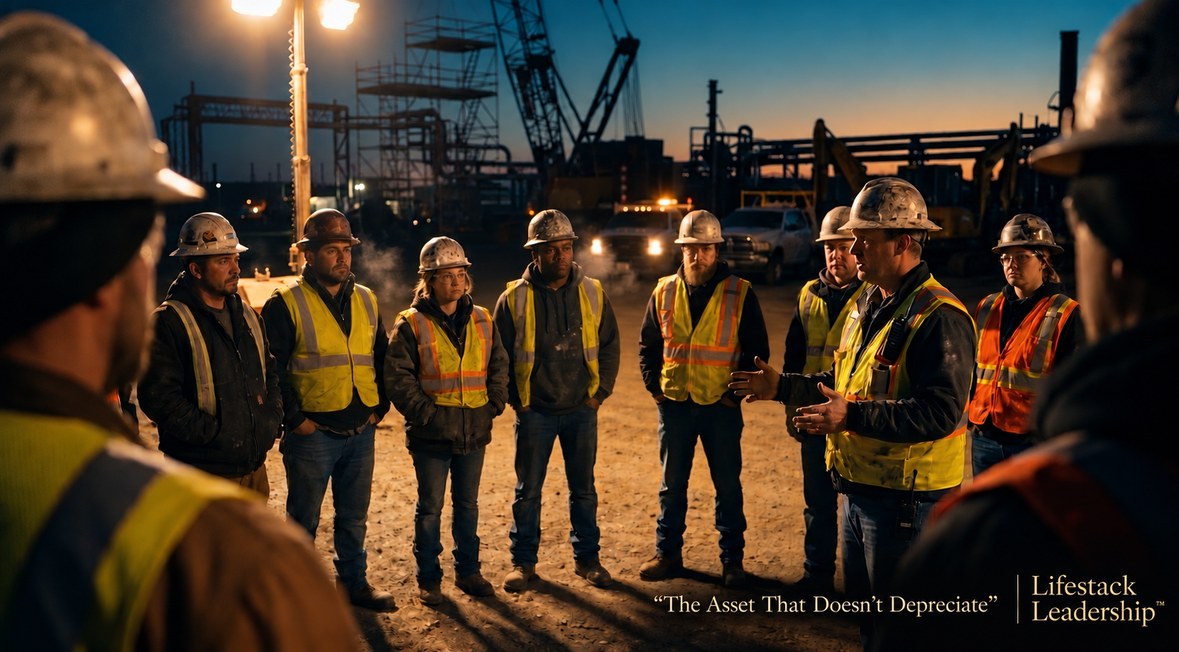
I've posted these findings individually over the past few weeks. Separately they read as data points. Side by side, I'd offer they form a theme.
What follows separates the two: the findings are cited and verifiable, the interpretations are mine and I hold them loosely.
The findings
Value is rare. Nearly nine in ten organizations use AI regularly; 37% attribute any EBIT impact; about 6% capture real value — unchanged in a year (McKinsey, Aug 2026).
Standardization pays. Leaders standardized on one approved platform report strongly positive ROI at roughly five times the rate of those still experimenting (Wharton, Oct 2026).
Work is shifting. Openings for routine roles fell about 13% while demand for analytical and creative roles rose about 20% (HBR, March 2026).
Work is intensifying. AI tools were found to intensify work rather than reduce it — faster pace, wider tasks, longer hours, with fatigue and weaker decisions downstream (HBR, February 2026).
The training gap. Meanwhile, most managers believe their people were adequately trained; noticeably fewer employees agree (Wharton).
What I'd propose they suggest
Every organization in those samples licenses the same models at the same price. So I'd offer the constraint isn't capability — it's organizational, which makes it ours.
And if routine work is contracting while judgment work expands, then the capability that matters can't be purchased. It's built, in people, over time.
Which may be the quiet case for human capital being the one asset that appreciates rather than depreciates — and the only one that can walk out the door.
Why I keep returning to transformational leadership
Burns argued in 1978 that it differs in kind from transactional exchange, raising both leader and follower — and that it carries a moral dimension. Northouse's synthesis gives us four components, and I'd suggest each maps onto this moment.
- Idealized influence: using these tools ourselves, inside the constraints we set for everyone else.
- Inspirational motivation: offering a frame better than the threat frame people will otherwise supply themselves.
- Intellectual stimulation: which Northouse notes includes inviting challenge to our own assumptions.
- Individualized consideration: going and asking, one person at a time — the only instrument I know for that training gap.
Where psychological safety enters
Amy Edmondson defines it as a shared belief that a team is safe for interpersonal risk-taking. Her work finds such teams don't make fewer errors, but rather surface more of them, earlier.
I'd propose that's the same requirement seen from the other side: we can invite challenge all we like, but people decide whether accepting is survivable. If our people are now verifying machine output, everything depends on whether "I don't think this is right" costs them anything to say.
Where the margin is thinnest
In most businesses a mistake is recoverable. In the industries I'm most familiar with from my career experiences, not uniformly.
We can rebuild a process, replace an asset, even recover a quarter. But there is nothing an organization can recover that returns a person to the people who loved them after an incident with irreversible consequences.
So I'd offer that research on fatigue and weakened decision-making lands differently for us. Not a productivity concern — a hazard.
Stop Work Authority exists because judgment about risk must be exercisable by anyone, immediately, without penalty. I'd propose psychological safety is that same control applied to cognitive work, and that it should also extend explicitly to AI output: anyone, at any level, able to say "I don't trust this and I'm not acting on it," and be thanked for it.
If human capital is truly our greatest asset, it means our people go home.
The asset that doesn't depreciate
If human capital is truly our greatest asset, that has to mean more than a line in a year-end note. It means our people go home. Everything else is downstream of that.
If you've found something that's made it easier for your people to speak up, I'd like to hear it in the hope it helps others working through the same thing.
Wishing you and your people a good closing quarter to the year, and a safe one, where everyone gets home to the people they matter to most.
Sources
- McKinsey & Company, "The state of AI in 2026: On the road to ROI," August 2026 (n=1,719).
- Wharton Human-AI Research & GBK Collective, 2026 AI Adoption Report, October 2026.
- Harvard Business Review, "Research: How AI Is Changing the Labor Market," March 2026.
- Ranganathan, A., & Ye, X. M., "AI Doesn't Reduce Work — It Intensifies It," Harvard Business Review, February 2026.
- Northouse, P. G., Leadership: Theory and Practice. Sage. Drawing on Burns (1978) and Bass (1985). The mapping to this moment is the author's analysis.
- Psychological safety per the work of Amy C. Edmondson, Harvard Business School.
Get the next issue in your inbox.
One briefing a month. The research, what it means for leaders, and one chapter from the field.