Everyone Bought the Tool. Almost No One Led the Change.
What McKinsey's 2026 State of AI reveals about leadership, and why ROI is a leadership metric.
Video overview below
Here are three numbers every executive team should have on the wall.
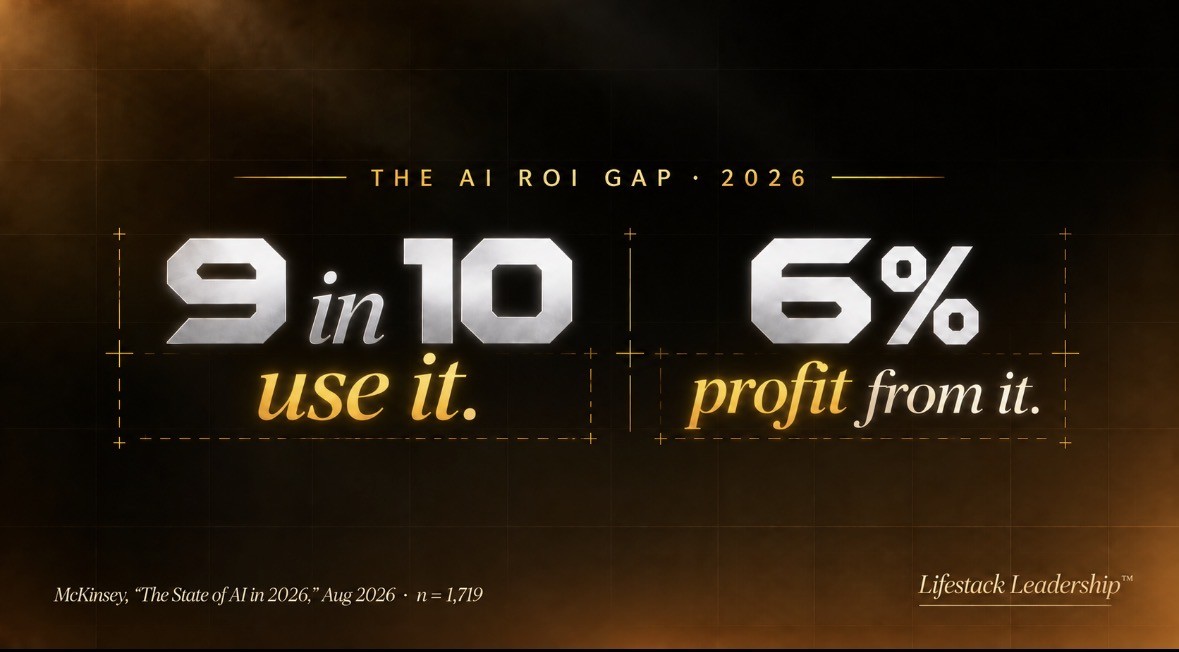
Nearly nine in ten organizations now use AI regularly in at least one business function. Thirty-seven percent can attribute any positive EBIT impact to it. About six percent qualify as high performers: organizations attributing at least 5% of EBIT to AI and calling the impact significant.
Adoption is close to universal. Value is rare. And the 6% hasn't moved in a year, even as investment and scaling have grown.
The productivity trap
The most revealing finding isn't about organizations. It's about people. Eighty percent of respondents say AI has improved their personal productivity. Half say it helps them make better decisions.
So the tools work. Individuals are faster. Yet enterprise financial impact has stayed flat.
I spent more than twenty years both engaging and leading operations in Fortune 250 environments: Utilities, Energy, Oil & Gas, Manufacturing, Maritime. We never got value from new equipment by installing it. We got value by rewriting the procedure, retraining the crews, and measuring the result against a baseline we'd set before the change.
AI works the same way. A recovered hour is capacity, not return. It becomes return only when a leader decides where it goes and someone measures what happens. Without that, the hours quietly disappear into the organization.
What the 6% actually do
McKinsey's high performers differ from everyone else in ways that are mostly about how they lead, not what they buy.
They redesign the work. Nearly three-quarters of high performers have fundamentally redesigned workflows because of AI, up from 55% a year ago. Among everyone else, it's one in four. The rest are inserting AI into step seven of a ten-step process and wondering why the process isn't faster.
Their leaders own it. High performers are twice as likely to say senior leaders show real ownership of AI initiatives through role modeling, sustained funding and visible championing.
They measure it. They are also twice as likely to have defined processes for quantifying AI's impact. You can't manage a return you never baselined.
They aim beyond efficiency. About 80% of all organizations pursue efficiency with AI. High performers also pursue growth and innovation, and they are 3.3 times more likely to intend fundamental business transformation.
They govern it. They are more likely to have decided when a human must stay in the loop, and to be actively managing AI risk.
McKinsey's authors point to the organization's capacity to absorb change as the increasingly binding constraint. That is a leadership problem, and leadership research has a name for the answer.
Northouse describes transformational leadership as a process that raises the capability and commitment of both leaders and followers. Its four factors map closely to what the 6% do:
- Idealized influence: leaders model the change themselves.
- Inspirational motivation: they aim beyond efficiency, toward growth.
- Intellectual stimulation: they redesign the work instead of automating the old steps.
- Individualized consideration: they develop people, not just deploy tools.
Buying the tool is a transaction. Sustaining the change is transformational.
An honest caveat
This is a self-reported, cross-sectional survey. It shows that high performers redesign workflows, measure and govern. It cannot prove those practices caused the EBIT results. Better-resourced organizations may simply do more of everything.
I don't read that as a reason to dismiss the findings. I read it as a reason to measure your own numbers. Industry averages won't convince your board. A before-and-after on your own workflow will.
Three moves for this quarter
- Redesign one workflow end to end. Don't choose the flashiest use case. Choose a recurring, measurable one, and rebuild it around what AI makes possible instead of adding a tool to the old steps. Built in, not bolted on.
- Open a ledger before you claim a result. Record baseline hours, the hours AI recovers, and where those hours were redeployed. Then report the number your CFO would accept, not the one your vendor would.
- Model it and govern it. Use the tools visibly. Then define your human-in-the-loop points the way safety-critical industries define Stop Work Authority: in advance, clearly, and with the explicit expectation that people will use it.
The question to ask instead
Many leaders are still asking how AI will reshape their teams. The better question is where the unclaimed value in your organization is, and what it would take to claim it.
I've spent the past few years building a leadership credential around that question. More on that soon.
Sources
- McKinsey & Company, "The state of AI in 2026: On the road to ROI," August 2026. Survey of 1,719 respondents, May 4–June 8, 2026. All figures are as reported by McKinsey.
- Northouse, P. G., Leadership: Theory and Practice. Sage. The mapping of the four factors to McKinsey's high performers is the author's analysis.
Get the next issue in your inbox.
One briefing a month. The research, what it means for leaders, and one chapter from the field.